
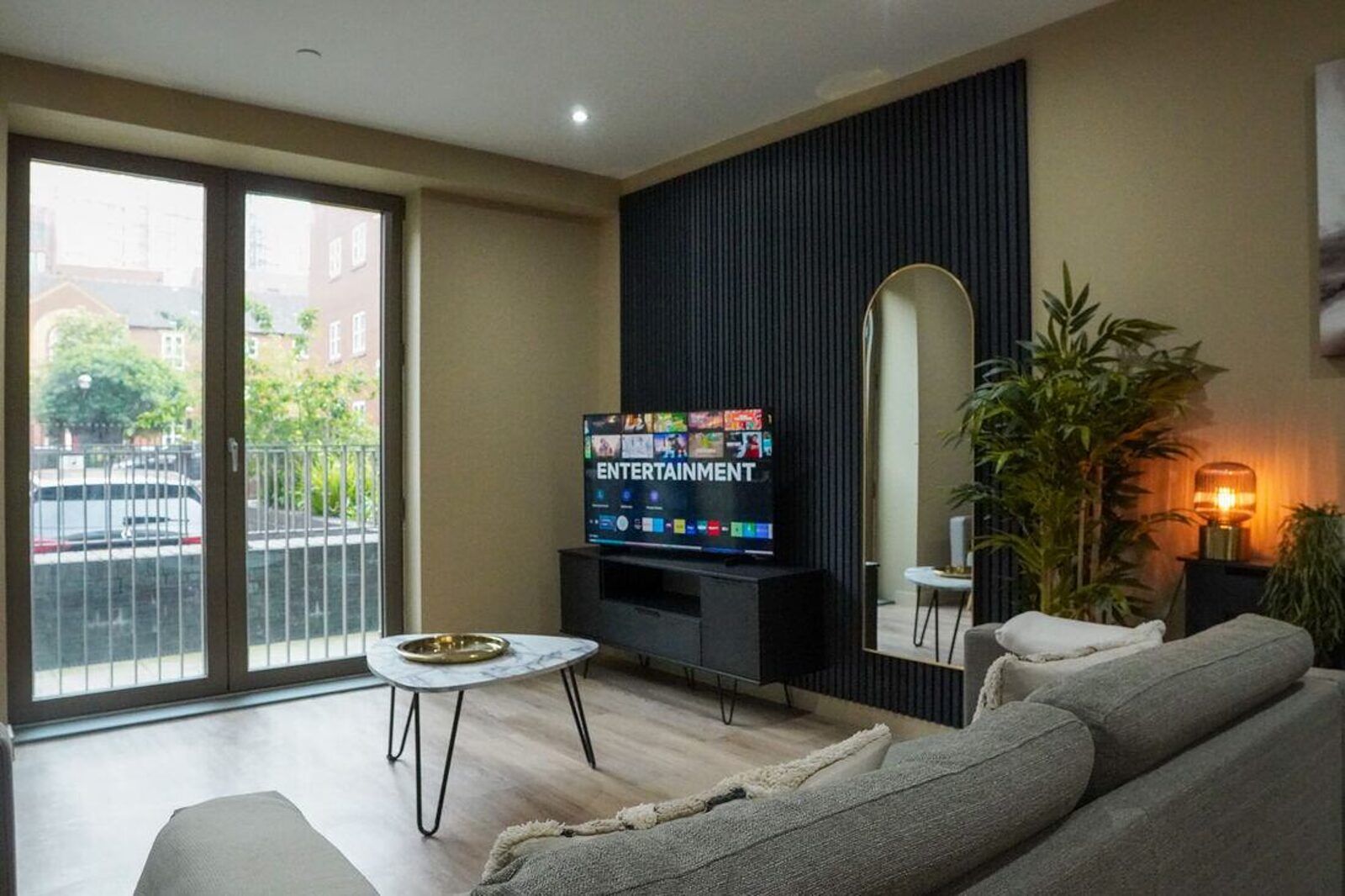
Insurance and displaced family stays in Derby
Insurance accommodation in Derby
Whole homes in Derby for families out of their house after a fire, a flood or an escape of water. Pets considered, schools taken into account, and the insurer invoiced directly.
Or call reservations on 0333 880 7213
The short answer
Alternative accommodation in Derby while your home is unusable.
If a fire, a flood or an escape of water has made your house unliveable, your policy almost certainly pays for somewhere else while it is repaired. That is called alternative accommodation, and it is what we provide in Derby: a whole furnished house or apartment, for as long as the works take, with the bills included and the invoice going to the insurer or the loss adjuster rather than to you. We deal with adjusters regularly and we know what they need in writing. Derby is an engineering city, so most stays here are midweek, multi-week and company paid.
Called a few different things
You will see this called several things and they all mean the same. Insurance accommodation Derby, alternative accommodation, displaced family accommodation, emergency accommodation, temporary accommodation after a flood or fire, loss of use accommodation, or simply what the policy calls alternative accommodation. If a loss adjuster has asked you to find somewhere, this is the page.
What the first week is actually like
Two hotel rooms, a microwave and the school run, for four months.
That is what usually happens first, and it is nobody's fault: the insurer needs somewhere immediately and a hotel is what is available at nine at night. It stops working within about a fortnight. A family needs a kitchen, separate bedrooms, somewhere to put the things that were salvaged and a school run that has not doubled. It suits you if:
Where you would be
Staying near your own life in Derby.
Staying inside the school run
In a claim the thing that matters most is rarely the kitchen. It is whether the children keep the same school, the same walk and the same friends. Derby's residential areas pull on different schools, so the useful question is not which suburb is nicest. It is which one leaves the existing routine intact while the work is done.
The residential areas, plainly
Allestree is north of the city, green and settled, close to Markeaton Park and the Derwent. Littleover and Mickleover are west, near Royal Derby Hospital. Darley Abbey is a small conservation village by the river. Chellaston sits south east towards the A50. They are genuinely different places rather than variations on the same suburb.
Parking for two cars
Most family housing in Derby assumes a car, often two, and a displaced family usually turns up with both plus whatever was rescued from the house. A driveway or a garage is worth more than a spare bedroom nobody uses. Permit only streets closer to the centre are where these arrangements tend to come unstuck in month three.
A claim runs longer than quoted
Fire and escape of water claims are measured in months, and the first estimate is rarely the real one. It is worth choosing somewhere you could tolerate through a winter instead of somewhere you can survive for six weeks. Space to work, somewhere to put the drying, and room for what survived all start to count.
A week in temporary housing
What keeps a household sane through a claim is the ordinary machinery: somewhere for wet coats and school bags, a washing machine that copes with a full family, an arrangement that works when both adults leave at once, and green space you can reach on foot. Darley Park and Allestree Park are the ones Derby families genuinely use.
Taking the first thing offered
The common error is accepting whatever is free in week one, because week one is chaos, then finding the school run has become a crawl across town in both directions. One awkward conversation early about area is worth it. Moving a second time in the middle of a claim is harder on everybody than waiting a few days at the start.
Winter is when claims start
Escape of water peaks in a cold snap, which is why so many households are displaced between December and February. The other local factor is the Derwent. Low ground near the river has taken water before, notably during the storms of October 2023, and flood defence work has been going on along it for years. Both are worth understanding.
Keeping weekends ordinary
Children handle a claim far better when Saturdays still look like the old ones. Calke Abbey is south of the city near Ticknall, the leisure centres and pools carry on as normal, and so do the same clubs and birthday parties if you have stayed in the right half of Derby. Continuity is the real argument for area over specification.
Booking direct
The same property, without the platform's cut.
Our properties are on Airbnb and Booking.com as well, and you are welcome to book there. Booking direct also avoids the guest service fee the big platforms add on top, which on a longer Derby stay is not a small number. Booking with us direct also means you are talking to the people who actually run the property rather than a message thread inside an app, which matters when you need an early check-in or an extra week.
Message reservations rather than booking online, and tell us the postcode you have come out of and which school or work you need to stay near. We will tell you honestly what we have close to it and what we do not, and we will deal with the adjuster directly from there.
In every property
What is actually there when you arrive.
Derby questions
What people ask about staying in Derby.
Which part of Derby should I be in?
Most of what you would need day to day sits in the city centre, the Cathedral Quarter, Pride Park and Darley Abbey. Tell us where you need to be each morning rather than which postcode you fancy, and we will be honest about what is close to it and what only looks close.
Can I park in Derby?
Derby is a driving city and most stays here need a car, because the employment sites are on the edge rather than in the middle. City centre parking is paid and the residential streets vary, so ask about the specific property if you are bringing a van or a second car.
How easy is it to get around Derby without a car?
Derby station puts Birmingham at forty minutes and London at an hour and a half, and the Peak District starts twenty minutes north.
What is there to do in Derby on a day off?
The Cathedral Quarter, Darley Abbey Mills and the Derwent Valley are on the doorstep, and the Peak District proper starts about twenty minutes north. For a city this size the countryside access is unusually good and it is most of what people end up doing on a weekend here.
Questions we get asked
What families and adjusters ask us.
Will the insurer pay you directly?
In almost every case, yes. We invoice the insurer or the loss adjuster on their terms, with the dates, the address and the claim reference, so you are not putting months of accommodation on a credit card and waiting to be reimbursed. Give us the adjuster's details and we will take it from there.
How long can we stay?
As long as the works take. Claims like this commonly run three to nine months and we would rather book you for the realistic length than move you twice. If the schedule slips, which it usually does, extending is a message.
Can we bring the dog?
Some properties take pets and some do not, so ask early rather than at the end. It is one of the most common reasons a hotel stops working for a family and one of the easiest things for us to solve if we know at the start.
We need to stay in the same school catchment.
Tell us the school and the postcode rather than the city. That is the constraint that actually decides this, and we would rather say we have nothing close enough than put you somewhere that adds forty minutes to every morning.
Check availability
Tell us the postcode you have come out of.
Message reservations with the postcode, how many of you there are and whether there is a pet, and we will tell you straight away what we have near you.
Reservations, seven days a week, on 0333 880 7213